
What's Inside
- Risks of Misidentified Species on Stamps
- Initial Source Cross-Check Protocol
- Species Identification Verification Steps
- Correction Logging and Date Stamping
- Step-by-Step Correction of Gyrfalcon Entry
- Sources & References
Risks of Misidentified Species on Stamps
A bird stamp database can look orderly while carrying a serious taxonomic fault. The page may show the right country issue, the right denomination, and a clean scan, yet still attach the wrong species name to the record.
That error travels farther than most collectors expect.
Where the Damage Starts
The editorial team moved taxonomic accuracy ahead of aesthetic cataloging after early database iterations showed a pattern: one wrong species label could distort collection valuations and mislead research notes that depended on the species catalog. A stamp filed as a Peregrine Falcon when the artwork and issue context support Gyrfalcon does not merely carry a spelling problem. It changes the biological identity of the entry.
For philatelists, that can affect search results, want lists, thematic groupings, and country issue comparisons. For ornithologists and researchers, it weakens the reference value of the archive because the same biological species may appear under more than one name.
Caution: Failure to update synonymies can create duplicate database entries for the same biological species under different historical names. The database then appears more complete than it is, while the underlying species mapping becomes less reliable.
Propagation Through Secondary Catalogs
Misidentifications rarely stay isolated. A collector copies a label from one catalog. A society checklist repeats it. A dealer listing inherits the same species name because the stamp number matches. By the time a correction reaches the species catalog, the false entry may already have become the easy answer.
The practical lesson is blunt: taxonomy fixes belong close to the record, not in a separate notes file that only one editor remembers.
Initial Source Cross-Check Protocol
The correction workflow begins with a single taxonomic authority. The database team standardized the baseline against the IOC World Bird List, using Gill and Donsker’s 2023 treatment as the reference point for contributor submissions. The Clements Checklist was not mixed into the same decision path, because parallel authorities create conflicting outcomes when a contributor asks which name should control the record.
Baseline Before Debate
This is a deductive step. First, establish the naming authority. Then test the stamp entry against it.
Every candidate correction receives three checks before a reviewer studies plumage: current accepted name, synonym status, and historical name used on the original database record. Entries using pre-2020 nomenclature receive a manual review flag. The flag does not mean the entry is wrong; it means the naming layer is old enough to deserve attention.
- Compare the stored species name against the current IOC World Bird List baseline.
- Mark older nomenclature for manual review rather than automatic replacement.
- Separate taxonomic synonymy questions from image-identification questions.
- Preserve the original label in the revision history when a correction proceeds.
Contributor Notes as Evidence, Not Commands
Contributor logs from Tino Mischler and Kjell Scharning helped isolate records that needed review. Those notes were treated as structured leads. They were not treated as database commits.
That distinction matters. A contributor may correctly notice that a stamp caption uses an outdated name, but the database still needs to test whether the artwork, issue metadata, and current taxonomy all support the proposed replacement.
Expert Tip: Keep contributor language intact in the note field. Normalize the database value, not the original observation. Later reviewers need to know whether the first flag concerned plumage, range, caption text, or synonymy.
Species Identification Verification Steps
Taxonomic names solve only part of the problem. Bird stamps add another complication: the artwork may simplify, stylize, or exaggerate field marks. A correct checklist name still has to match the bird printed on the stamp.
Plumage and Range Come First
The review team uses side-by-side comparison between the stamp image and modern ornithological field guides. The first pass looks for visible plumage characters. The second pass tests geographic plausibility against the country issue and the subject announced by the postal authority, when available.
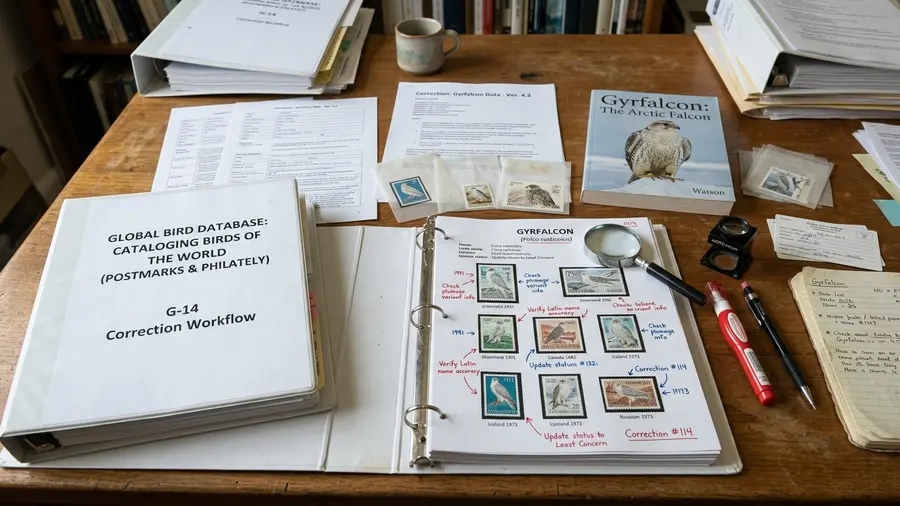
In the Gyrfalcon case, the replacement of a prior Falco peregrinus label with Falco rusticolus depended on more than a modern name preference. The visible structure, pale morph treatment, and issue context supported Gyrfalcon rather than Peregrine Falcon. Variations in stamp printing quality can obscure key diagnostic features like the breast barring on raptors, so the reviewer must decide whether the visible evidence is sufficient for a species-level correction.
Contrasting Clear and Difficult Updates
Some updates are taxonomic housekeeping. Others require visual identification.
The Otus semitorques and Scotopelia peli updates were validated against primary field guide illustrations because the image traits mattered. The Zosterops japonicus synonymy with montanus, by contrast, belonged mainly in the nomenclature layer. Both corrections improve the species catalog, but they do not demand the same kind of evidence.
One catch deserves a permanent place in the protocol: heavily stylized or monochromatic stamp engravings often lack diagnostic plumage markers. In those cases, a reviewer should not force a definitive species identification from weak visual evidence. The record can carry a note explaining the uncertainty while the taxonomic label remains conservative.
Main Point: Field guides are not interchangeable proof. In this workflow, they test visible traits against a single taxonomic baseline and against the issue context already stored in the database.
Correction Logging and Date Stamping
A correction that cannot be traced is only half a correction. The database architecture therefore appends date-stamped revision logs directly to the affected taxon records rather than storing changes in offline spreadsheets.
What the Log Must Capture
The log needs enough detail for a later editor to reconstruct the decision without reopening the whole dispute. It does not need a long essay. It needs controlled fields and one precise note.
- Original species name as stored before correction.
- Revised species name and authority baseline used.
- Country issue and catalog reference affected by the change.
- Date of database revision.
- Contributor or reference note that triggered the review.
- Evidence type: plumage, range, synonymy, issue text, or published reference.
The April 2023 Canada SG 1760 change and the October 2022 Japan set revision show why the log belongs on the taxon record itself. Both changes affect how users move between country issues and the species catalog. If the revision sits in a spreadsheet, the public record looks static even after the underlying mapping changes.
Reference Attachments
Steve Strauss Flight magazine references are attached where applicable, especially when the correction depends on published identification discussion rather than a simple name update. The attachment should name the reference, state what it supports, and avoid implying that one article governs the whole taxon.
For synonymy cases such as Zosterops japonicus with montanus, the revision note should make clear whether the database merged duplicate entries, redirected an older name, or retained both labels for historical search compatibility.
Step-by-Step Correction of Gyrfalcon Entry
The Gyrfalcon correction is the cleanest working model because it combines all three layers: contributor flag, visual diagnosis, and taxonomic replacement.
Correction Sequence
- Locate the original listing. Search the species catalog for the stored F. peregrinus entry and open the connected country issue record.
- Confirm the issue context. Check the country issue metadata, catalog reference, and any caption text attached to the stamp scan.
- Read the contributor note. Preserve the Tino Mischler contribution in the review field before making any species-name edit.
- Compare visible field marks. Review the stamp artwork beside field guide illustrations, focusing on structure, plumage pattern, and raptor breast markings where the print quality allows it.
- Apply distribution checks. Test whether the proposed Falco rusticolus identification fits the issue subject and geographic framing better than Falco peregrinus.
- Update the accepted species name. Replace the prior Falco peregrinus label with Falco rusticolus only after the image and range checks support the move.
- Date-stamp the revision. Add the correction date, authority baseline, contributor credit, and evidence category to the taxon record.
Why This Order Holds
The order prevents a common mistake: changing the name because a contributor is probably right, then looking for evidence afterward. The database should make the correction because the evidence supports it. Contributor expertise starts the review; it does not replace the review.

Once committed, the Gyrfalcon entry should remain discoverable from the older Peregrine label through a historical note or redirect term. That protects users who arrive through older philatelic literature while keeping the accepted species mapping clean.