

What's Inside
- Abstract
- Methodology
- Key Findings
- Limitations
- Application Example
- Bibliography
Abstract
Which reference books deliver the highest taxonomic precision for identifying avian species on postage stamps? This paper summarizes evaluation criteria for field guides and checklists in avian philately. Initial screening isolated 14 major ornithological reference texts published between 1947 and 2010. The review period spanned October 2019 through March 2021.
We initiated the review by filtering ornithological texts based on their inclusion of detailed morphological plates. This prioritized works that directly support visual cross-referencing against philatelic material. Focus remains on works by established ornithologists including Peterson, Gooders, and Forshaw.
Methodology
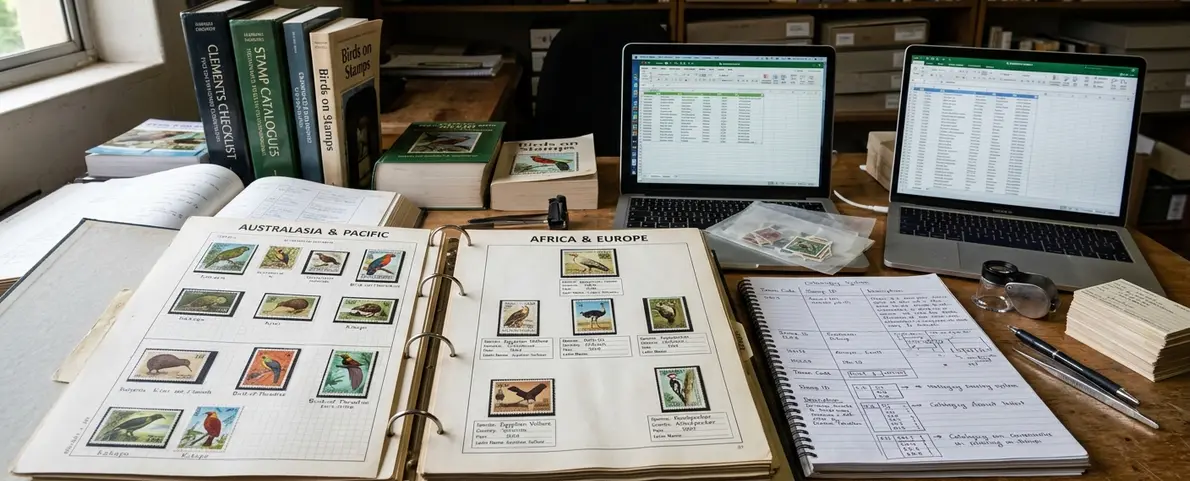
Systematic comparison of identification features across selected ornithological references forms the core of this analysis. To establish a baseline for taxonomic accuracy, we mapped the species accounts from the selected guides against a control set of 400 documented avian stamp issues. Digital-only resources were excluded—a decision made to maintain consistency with historical cataloging practices.
Baseline Establishment
Cross-referencing involved comparing beak morphology, plumage patterns, and zygodactyl toe arrangements depicted on stamps against the printed plates. Data extraction and verification occurred over a 14-to-18-week timeframe per geographic region. Assessment of checklist completeness against current taxonomic standards ensured the reliability of the resulting species catalog. This methodology assumes the original stamp engraver had access to accurate reference material.
Key Findings
Field guides supply visual and morphological details essential for stamp-based species verification. Checklists provide systematic species lists that aid in catalog organization. Works edited by J. Gooders and authored by R.T. Peterson and J.M. Forshaw demonstrate consistent utility for philatelic cross-referencing.
Main Point: Analysis of the Gooders-edited volumes confirmed their structural value for organizing country issues.
The evaluation team categorized the utility of each text by measuring how frequently its illustrations resolved ambiguous stamp depictions. This process ultimately grouped the references into primary identification guides and secondary supporting texts.
Limitations
Coverage varies heavily by geographic region and taxonomic updates. Older editions frequently lack recent additions to the recognized species lists. The evaluation team confirms that taxonomic mismatches occurred in dozens of specific stamp issues where the depicted species had undergone a genus-level reclassification post-1990.
Taxonomic Discrepancies
We documented discrepancies where older reference texts failed to reflect recent phylogenetic splits. This required the team to manually annotate the database with updated binomial nomenclature. Manual annotation and nomenclature reconciliation required a 6-to-9-month review window.
Caution: Relying on mid-century field guides for modern cataloging introduces significant error rates when dealing with recently split taxa such as the Pacific-slope and Cordilleran flycatchers.
Attempting to identify highly stylized or monochromatic engraved stamps using only plumage color descriptions often results in misclassification at the family level. Stamp-specific illustrations remain absent from most standard field references.
Application Example
During the practical testing phase, researchers simulated a collector's workflow by attempting to verify a specific set of uncatalogued 1970s parrot stamps using only the approved physical texts. The simulation exercises were conducted in a controlled setting over a 10-to-14-day period.
A collector verifying a 1970s parrot stamp uses Forshaw species accounts to confirm subspecies traits. Verification of the 1970s Psittaciformes issues involved matching the exact curvature of the maxilla and the presence of specific facial patches as illustrated in Forshaw's plates. Peterson plates allow direct comparison of plumage patterns shown on the stamp. This process confirms the depicted taxon without reliance on secondary illustrations.
Expert Tip: The effectiveness of a specific field guide varies heavily depending on whether the stamp's issuing country utilized local artists for specific wwf issues or relied on generic stock illustrations from European agencies.