A Margin Name Beside a Plate That Does Not Match
A mint block from a Neotropical national issue rests on a quiet reading-room desk. The bird portrait occupies little space; the scientific name runs along the margin. Under a loupe, the curve of the upper bill becomes distinct. It appears difficult to reconcile with the bird named beside it.
The first useful comparison stays on the paper. The examiner follows the culmen, checks the barring on the tail feathers, and locates the coloured patch around the ear coverts. A general catalogue number can wait until those visible features have been recorded.

That small discrepancy opens three lines of inquiry: how philatelic and ornithological commentary judges portrait accuracy, how later accounts handle names that change after release, and how issuing countries select endemic birds as cultural emblems. Each requires a different kind of evidence.
The block remains the starting point. Its inscription records a historical identification; its printed bird supplies characters that a reader can examine independently.
What Makes an Endemic Bird Portrait Identifiable?
Diagnostic characters carry more weight than overall resemblance. A convincing silhouette may still lack the feature needed to distinguish closely related birds. Useful checks include bill-edge shape, bare orbital skin, the relative lengths of outer tail feathers, and the position of a restricted gorget or wing bar.
Comparison with a field description should establish whether those characters agree as a group. A single colour patch deserves caution when printing has softened its boundary. Commentary on individual issues supports qualitative judgments about particular portraits; it supplies no basis here for a regional accuracy rate.
Separate the Artwork, Printing, and Caption
Three faults require separate records:
- Artist reference error: the reference artwork gives the bird an incompatible culmen hook or lore patch.
- Plate registration shift: displaced cyan or magenta moves the apparent edge of a gorget or another coloured feature.
- Post-issue catalogue mislabeling: a catalogue attaches the wrong name to the issued design.
An article reproducing only the finished stamp can describe the visible discrepancy. Establishing its origin requires more: access to reference artwork for a design error, a sufficiently clear impression for registration assessment, or comparison with the original inscription for a transcription error. A soft impression and an incorrect caption should occupy different fields in the species catalog.
Postal and Portrait Quality
A stamp can be a sound postal object yet a weak species portrait. Conversely, a clearly identifiable bird does not establish the printing quality or condition of the collectible.
When Checklist Names Move After the Issue Date
The release date anchors the identification trail. Preserve the printed caption before applying a later classification.
- Record the issue year and transcribe the scientific name exactly, including any printed authority and date.
- Consult the later checklist and determine whether the change concerns a split, a lump, a generic reassignment, or merely checklist order.
- Keep the historical caption beside the current identification, with the basis for any narrower assignment.
These changes have different consequences. A generic reassignment may alter the binomial while leaving the represented bird's identity intact. A split can make the old caption broader than the current species concept. Sequence changes affect arrangement without necessarily changing identification.
Dual-caption logging keeps both readings available. The original inscription belongs to the country issue; the later name belongs to the checklist treatment being used. Identification guides and recent additions to an archive benefit from retaining that distinction.
Date Before Renaming
Write the issue year beside the printed name before updating the record. Never backdate a later split onto the original selvedge caption. If the portrait lacks distinguishing characters, retain the broader historical identification and leave the narrower assignment unresolved.
How Country Issues Turn Endemics into Emblems
A range-restricted bird placed beside a national coat of arms, topographic contours, or regional flora acquires a second function. The sheet presents the bird within a statement about place. Conspicuous plumage can support that visual task more readily than the subtle characters of a cryptic species.
Read the Emblem or Audit the Inventory?
The cultural reading works best when examining composition: which bird receives prominence, which local motif accompanies it, and how the release text connects the two. The inventory reading requires distributional evidence and a defined geographic boundary. A commemorative selection documents the postal authority's choice; it cannot establish a country's complete endemic list.
Keep those methods separate when recording wildlife series or wwf issues. Decorative framing belongs in the issue description. A claim of national endemism belongs beside a distribution check, particularly when a bird's range may cross a political border.
Keep Selection Local
A single issue note or interpretive essay supports conclusions about its own material. Extending that account to all Neotropical postal authorities would require evidence beyond the individual release.
Bibliography
The supplied material identifies no individual publication by author, title, and publisher or journal. Consequently, no bibliographic entries can be verified here. An issue-specific record should retain the official release bulletin, the checklist edition used for identification, and any research article supporting the diagnostic comparison. Unverified secondary listings should remain outside the reference list.
One Cancelled Block Against a Current Checklist
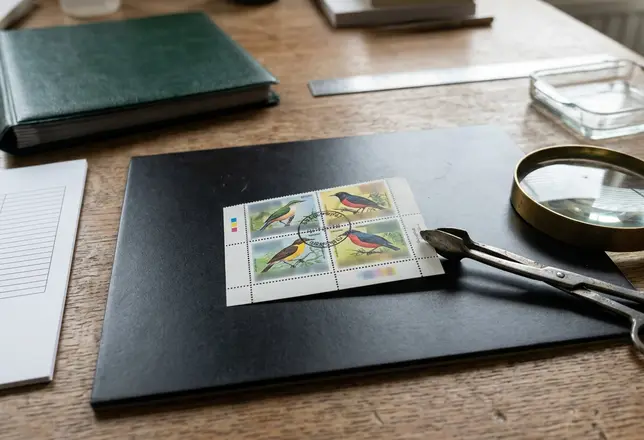
At the reading-room table, a reader moves a cancelled block onto the blotter and angles the lamp across its surface. The first pass follows the diagnostic mark under the loupe: bill profile, tail pattern, then the boundary of the small plumage patch. A cancellation crosses part of the wing, so that character remains unscored.
The second pass moves to the margin. The reader copies the printed binomial beside the issue year, then places the current checklist name alongside it, preserving the older caption.
For the third pass, the release text lies open beside the checklist's distribution account. The reader checks whether the claimed endemic range fits the stated boundary, adds a short note to the ledger, and slips the block back into its sleeve.